

How Stage Gate + Framing Give Prosci and ADKAR a Strategic Edge

Change management has never been more in demand.
Scroll through LinkedIn and you’ll find hundreds of job openings for Change Managers -across every sector: digital transformation, sustainability, technology adoption, cultural change, mergers, and restructures.
Organizations know that transformation fails without people who can lead it. But here’s the truth: change management alone is no longer enough.
If you want to create a competitive advantage as a change professional, you need to master not only Prosci and ADKAR, but also Stage Gate and Opportunity Framing and, more importantly, know how to explain the difference.
What Is Prosci and the ADKAR Model?
Prosci is one of the world’s leading authorities in change management research and training. Its two core frameworks are:
The ADKAR Model - which focuses on individual change through five elements:
A – Awareness: understanding why the change is needed
D – Desire: wanting to support the change
K – Knowledge: knowing how to change
A – Ability: being able to implement new skills or behaviors
R – Reinforcement: sustaining the change over time
The Three-Phase Organizational Change Process, which helps structure how change is implemented at scale:
Phase 1 – Prepare Approach: define approach, impact, success
Phase 2 – Manage Change: engage stakeholders, execute plans, and monitor progress
Phase 3 – Sustain Outcomes: review performance, measure results, and ensure longevity
Together, these frameworks provide a strong foundation for PEOPLE-DRIVEN CHANGE. But they assume that the initiative itself is already well-defined and strategically aligned - and that’s often where the trouble begins.
The Limitations of Traditional Change Management
Even well-structured change programs fail when the wrong project or unclear goals are pursued.
Common mistakes include:
Jumping straight into communications and training before validating the business problem.
Assuming executive alignment that isn’t really there.
Confusing activity with progress - “managing” a change that lacks strategic clarity.
Ignoring decision-making and governance as part of the change process.
Treating change management as an add-on, rather than part of the organization’s decision framework.
In many cases, these failures could have been avoided if the initiative had been framed and governed correctly at the front end.
Where Stage Gate + Opportunity Framing Fit In
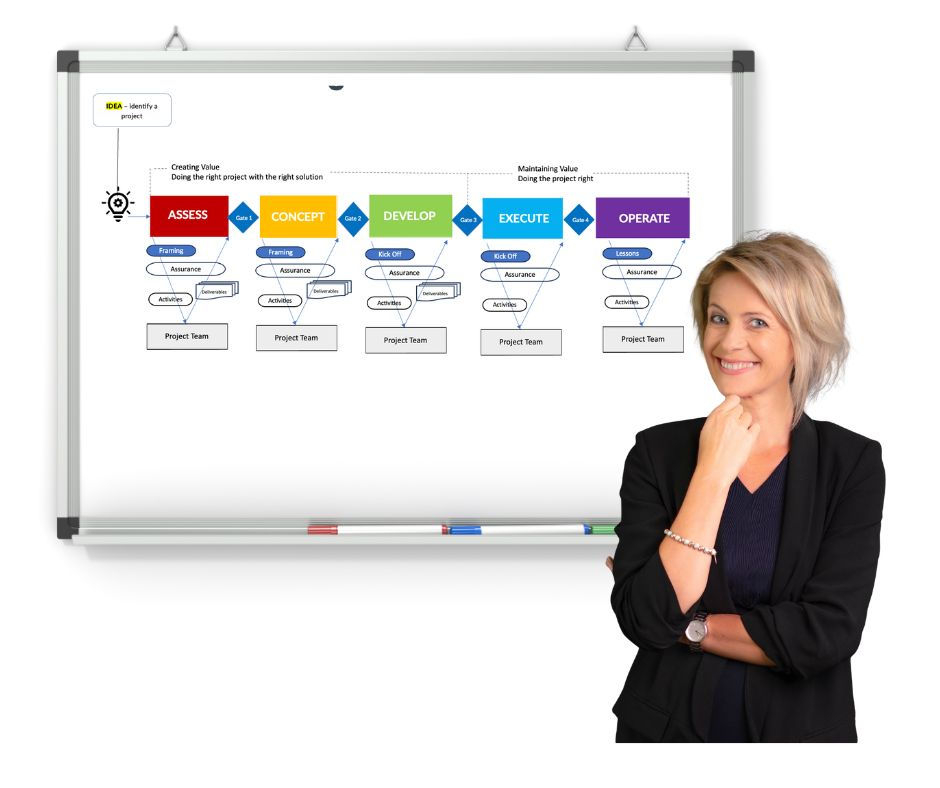
The Stage Gate process provides the governance and decision discipline that complements Prosci’s people focus. It divides a project into phases, separated by gates where leadership reviews value, alignment, and readiness before approving the next step.
Typical stages include:
Assess: What problem or opportunity exists? Where is the value going to come from?
Concept: What is the best option to pursue?
Develop: Prepare and resource the plan.
Execute: Implement the change.
Operate: Measure benefits and ensure sustainability.
Opportunity Framing supports this by ensuring that before any execution begins, leaders and stakeholders are aligned on:
The real problem or opportunity
What success looks like
The range of possible options and decision criteria
The key risks, assumptions, and givens
Who will make decisions and when
What's the min amount of work required to realize the change
Together, Stage Gate and Framing ensure that the right change is being pursued, not just that people are adapting to it.
How They Complement Prosci’s 3-Phase Process
Stage Gate and Opportunity Framing perfectly complement Prosci’s three-phase change process by adding structure and strategic clarity to each step:

This integration bridges the gap between organizational decision-making and people adoption - ensuring that both are addressed together, not separately.
How Framing Facilitators and Change Managers Work Together
A framing facilitator helps kick-start the change before the formal change management process begins:
Before the Change (Framing + Early Gates) Facilitator brings leaders and stakeholders together to define the opportunity. Strategic alignment and value proposition are clarified. Key decisions, givens, and risks are identified. The outcome is a clear roadmap approved at Gate 1 and Gate 2.
During the Change (ADKAR + Mid Gates) Change managers use ADKAR to guide awareness, desire, knowledge, and ability. Stage Gate checkpoints include reviews of both technical and human readiness.
After Implementation (Operate + Reinforcement) Reinforcement plans are aligned with the final gate review. Lessons learned feed into future opportunity framing sessions.
This partnership transforms change management from a reactive support function into a strategic enabler of value.
Real-World Examples
1. Digital Transformation in a Manufacturing Company
A manufacturer launched an enterprise software rollout to “standardize operations.” Despite heavy investment in training, adoption was poor.
A midstream Opportunity Framing session revealed that leadership had never agreed on what “standardization” meant. After reframing and resetting through the Stage Gate roadmap, executives defined clear goals and criteria for success.
Once aligned, the change manager applied Prosci’s three-phase approach - engaging stakeholders, managing transition, and reinforcing new behaviors. Within six months, user adoption increased by 70% and efficiency targets were met.
2. Culture Change in an Energy Company
An energy company launched a “safety-first” initiative. Communication campaigns rolled out, but behavior didn’t change.
A framing facilitator was brought in to redefine the opportunity. The goal shifted from “compliance improvement” to “empowering safe decision-making.”
This new frame shaped leadership messages, engagement plans, and metrics. Stage Gate governance ensured readiness reviews considered both process and behavioral change, while the ADKAR model supported employees through awareness, desire, and reinforcement. Within a year, incidents dropped, and engagement scores rose across all departments.
Why This Combination Creates a Competitive Advantage
Change managers who integrate Stage Gate and Opportunity Framing with Prosci’s process stand out because they:
Enter projects earlier, helping define the change - not just deliver it.
Bridge strategy, governance, and people adoption.
Speak the language of executives and sponsors, focusing on decision quality and value.
Build credibility by aligning people readiness with project readiness.
Prevent wasted effort on misaligned initiatives.
This is how change managers evolve into change strategists and decision enablers - the professionals organizations truly need in an era of constant transformation.
The Bottom Line
LinkedIn may be full of jobs for Change Managers. But the ones who will stand out and shape the future of transformation - are those who can confidently say:
“I don’t just manage change. I help organizations frame it, decide on it, and deliver it - with clarity and alignment.”
If that’s the kind of leader you want to become,
👉 check out our course Mastering the Decision Gate Process - now available at a One-More-Day Special Price. Go to https://academy.wilson.biz/
You’ll learn how to combine Stage Gate and Framing can become a powerful approach that drives clarity, alignment, and measurable results.
Because true change leadership doesn’t start with communication. It starts with framing the right change.


Comments